TRAVEL-GUIDES
CoolStays Guide to the South Downs National Park
8th September 2020
The South Downs National Park is a gigantic swathe of marvellous landscape that has been shaped by thousands of years of human habitation. It sits within three counties in the South East - East and West Sussex, and Hampshire - and stretches for 140km from Winchester to Eastbourne. With rolling chalk downland, enchanting woodland heaths, and striking white cliffs that fall into the sea, it's a truly magical location.

Best things to do in the South Downs
The South Downs Way
First up, avid walkers and cyclists will want to set out and see as much of the landscape as possible. And the best way to do this is by venturing out onto the South Downs Way that spans the entire length of the park. This was the first bridleway National Trail in England and is a 160km route that is beautiful, diverse, and almost entirely off-road!
With so much on offer you can choose a section and walk it as quickly or as leisurely as you want - we like to wander at a snail’s pace from quaint country pub to quaint country pub.
Things to do on the South Downs Way
- Hike scenic stretches between Winchester and Eastbourne, enjoying rolling chalk hills and coastal views
- Cycle long-distance off-road tracks designed for mountain bikes and gravel riders
- Stop at traditional country pubs and tearooms along the trail for rest and local flavours
- Explore historic landmarks such as Iron Age hillforts, ancient churches, and charming villages
- Spot wildlife including skylarks, butterflies, and rare chalk downland flowers
- Extend your adventure with horse riding on designated bridleways
- Capture sunrise and sunset views from high ridges like Ditchling Beacon and Devil’s Dyke
Getting to the South Downs Way
- Southern gateway: Start at Winchester – easily reached by direct trains from London Waterloo
- Eastern gateway: Finish at Eastbourne – with rail links to London Victoria and coastal towns
- Drive via the A27, A23, or M3, with parking spots at key villages and trail access points
- Regional bus services connect towns like Lewes, Petersfield, and Brighton to nearby trailheads
- Bike-friendly trains allow easy transport of cycles to jump on and off the trail
- National Express coaches serve Brighton, Winchester, and Eastbourne for budget-friendly access

Devils Dyke
Devil’s Dyke serves up one of the most striking views in the National Park and one that painter John Constable considered “the grandest in the world”. The Dyke is a deep and long grassy valley that’s carved right into the hills. At 100 metres deep, 1km long, and 400 metres wide from rim to rim, the Devil’s Dyke is a real spectacle.
There are a number of fantastic walking routes from the Dyke, as well as plenty of activities to partake in from hang-gliding and model airplane flying to simply picnicking on a hillside in the sunshine.
There are a number of fantastic walking routes from the Dyke, as well as plenty of activities to partake in from hang-gliding and model airplane flying to simply picnicking on a hillside in the sunshine.
Things to do at Devil’s Dyke
- Walk along the spectacular chalk escarpment with panoramic views over the Weald and South Downs
- Try paragliding or hang gliding, with Devil’s Dyke known as one of the UK’s best launch sites
- Explore walking and cycling routes that connect to the South Downs Way
- Enjoy a meal or drink at the Devil’s Dyke pub, perched right on the edge of the valley
- Discover the geology and folklore behind the largest dry valley in the UK
- Spot wildflowers and butterflies in summer, with rich chalk grassland habitats
Getting to Devil’s Dyke
- By car: Just 10 minutes from Brighton via the A27 and Saddlescombe Road; car park available on site
- By bus: The 77 bus from Brighton runs directly to Devil’s Dyke (seasonal service)
- By train: Arrive at Brighton Station, then connect via bus or taxi to the Dyke
- On foot: Join Devil’s Dyke as part of the South Downs Way for longer hikes
- Cycling access: Popular route for road cyclists and mountain bikers, with trails leading up from Brighton and surrounding villages
Seven Sisters
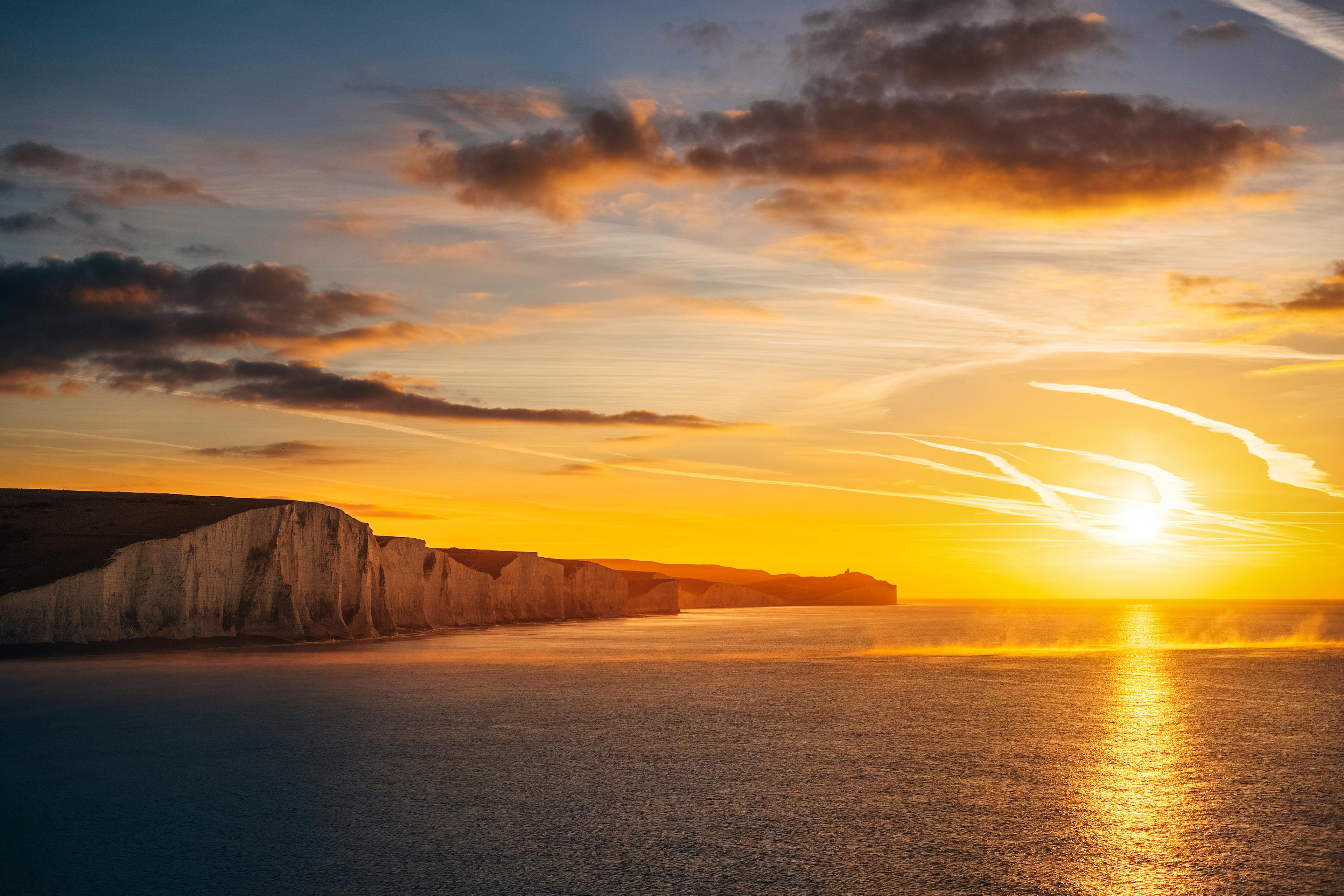
A quintessentially British view, the chalky, rippling cliffs of the Seven Sisters really are a sight to behold. They rise up from the beach between Seaford and Eastbourne, and include the famous beauty spot of Beachy Head.
These cliffs are designated and protected as a 'Heritage Coast' and offer up the most perfect example of chalk cliffs in Britain. Visitors to the Seven Sisters will also be able to wander along a meandering river valley that twists and turns through large open grassland that is a popular spot for activities such as walking, bird watching, canoeing and paddle boarding.
These cliffs are designated and protected as a 'Heritage Coast' and offer up the most perfect example of chalk cliffs in Britain. Visitors to the Seven Sisters will also be able to wander along a meandering river valley that twists and turns through large open grassland that is a popular spot for activities such as walking, bird watching, canoeing and paddle boarding.
Things to do at the Seven Sisters
- Walk the iconic chalk cliffs for breathtaking views of the English Channel
- Follow the coastal trail from Seaford to Eastbourne, one of the UK’s most scenic hikes
- Explore the Cuckmere Valley with its meandering river and wildlife-rich wetlands
- Visit the Seven Sisters Country Park visitor centre for maps and local information
- Enjoy birdwatching and photography, especially at sunrise or sunset
- Relax on the shingle beach at Cuckmere Haven, with the cliffs as a dramatic backdrop
Getting to the Seven Sisters
- By car: Access via the A259 between Seaford and Eastbourne; car parks at Seven Sisters Country Park and nearby villages
- By train: Travel to Seaford or Eastbourne stations, then connect via bus or taxi to trailheads
- By bus: The 12, 12A, and 12X Coastliner services link Brighton, Seaford, and Eastbourne with stops near the park
- On foot: Join the South Downs Way or shorter circular walks starting at the visitor centre
- Cycling access: The coastal road and nearby country lanes offer cycle routes to reach the cliffs

The Kingley Vale Trail
We’ve ticked off giant vistas and huge, sheer white cliffs, and now it’s time to take you to one of the most underrated forests in the UK. This reserve, which is located near Chichester, has one of the finest yew forests in western Europe, which includes a grove of trees that are known to be among the oldest living things in Britain!
Enjoy wandering around these gnarled old trees with twisting trunks and arching branches, whilst keeping your eyes peeled for green woodpeckers, buzzards and bee orchids!
Enjoy wandering around these gnarled old trees with twisting trunks and arching branches, whilst keeping your eyes peeled for green woodpeckers, buzzards and bee orchids!
Things to do on The Kingley Vale Trail
- Walk through the ancient yew forest, home to some of the oldest living trees in Britain
- Climb to the Devil’s Humps, a set of Bronze Age burial mounds with sweeping views over Chichester Harbour
- Spot wildlife and bird species, including green woodpeckers, buzzards, and butterflies
- Explore the chalk grassland habitats rich with orchids and rare wildflowers
- Enjoy a family-friendly circular walk with varied landscapes from woodland to open downland
- Take in the panoramic views across the South Downs National Park and beyond
Getting to The Kingley Vale Trail
- By car: Parking available at West Stoke car park, just north-west of Chichester off the A286
- By train: Travel to Chichester Station, then connect by taxi or local bus towards West Stoke
- By bus: Local services from Chichester stop near Funtington, within walking distance of the reserve
- On foot: Link Kingley Vale with longer South Downs Way routes for a full-day hike
- Cycling access: Cycle-friendly lanes lead to West Stoke; bike racks available at the trail entrance

Make sure you sample the local produce!
This region is a treasure-trove for lovers of food and drink. There are over 20 vineyards, and more than 50 breweries in the South Downs, many of which offer you the chance to enjoy a tour and sample their goods - just make sure you’re not the designated driver!
The South Downs also has exquisite dairies that produce over 80 regional cheeses, as well as many award-winning artisanal food-makers. So you can enjoy delicious ice cream, beautiful charcuterie, and decadent pies, along with a whole host of other tasty treats.
The South Downs also has exquisite dairies that produce over 80 regional cheeses, as well as many award-winning artisanal food-makers. So you can enjoy delicious ice cream, beautiful charcuterie, and decadent pies, along with a whole host of other tasty treats.
Best towns and villages in the South Downs
Lewes
A historic market town with a bohemian spirit, Lewes is packed with independent shops, galleries, and cafes. The medieval castle and Anne of Cleves House are must-sees, while the riverside and cobbled lanes make for a leisurely wander. Lewes also has a strong foodie reputation, with everything from artisan bakeries to traditional pubs.
Things to do in Lewes
- Explore Lewes Castle and enjoy panoramic views over the town
- Visit the Anne of Cleves House, part of Henry VIII’s historic estates
- Browse independent shops, galleries, and antique stores in the town centre
- Take a walk along the River Ouse or up to the South Downs ridge
- Sample local beers at the famous Harvey’s Brewery
How to get to Lewes
- By train: Direct services from London Victoria and Brighton
- By car: Easily reached via the A27 and A26
- By bus: Regular services from Brighton, Uckfield, and surrounding villages
Midhurst
At the heart of the South Downs, Midhurst is a picturesque town with timber-framed buildings, boutique shops, and excellent eateries. Nearby you’ll find Cowdray Ruins and the polo grounds, which host world-class matches in summer. It’s an ideal base for exploring both the Downs and the nearby Weald.
Things to do in Midhurst
- Wander the Cowdray Ruins, a Tudor mansion with striking remains
- Watch a polo match at the Cowdray Park Polo Grounds
- Stroll through the town’s independent shops and cafes
- Explore the South Downs Way and local walking trails nearby
- Visit the South Pond and woodlands for a peaceful nature walk
How to get to Midhurst
- By car: Located on the A272, linking to Petersfield and Petworth
- By bus: Services connect with Chichester, Petersfield, and Haslemere
- By train: Nearest stations are Haslemere and Petersfield, with bus/taxi connections
Chichester
This cathedral city blends Roman heritage with a lively arts scene. Visitors can explore Chichester Cathedral, wander through the historic city walls, or enjoy performances at the renowned Chichester Festival Theatre. With shops, restaurants, and easy access to the coast, it offers the best of both culture and countryside.
Things to do in Chichester
- Tour the Chichester Cathedral with its famous spire and artworks
- Visit Fishbourne Roman Palace, one of the UK’s largest Roman sites
- Explore the city walls and historic centre on foot
- Enjoy a performance at the Chichester Festival Theatre
- Shop and dine in the city’s boutiques, cafes, and restaurants
How to get to Chichester
- By train: Direct links from London Victoria, Brighton, and Portsmouth
- By car: Accessible via the A27 coastal route
- By bus/coach: Services from across Sussex and Hampshire
Winchester
As the ancient capital of England, Winchester is rich in history and charm. Its cathedral is one of the largest in Europe, while the Great Hall houses King Arthur’s legendary Round Table. The city’s vibrant markets, riverside walks, and excellent restaurants make it a gateway town for the South Downs Way.
Things to do in Winchester
- Visit the Winchester Cathedral and explore its crypt and historic library
- See the Great Hall and the iconic Round Table
- Browse the High Street markets and independent shops
- Walk along the River Itchen or join the start of the South Downs Way
- Explore the Wolvesey Castle ruins
How to get to Winchester
- By train: Frequent direct trains from London Waterloo, Southampton, and Basingstoke
- By car: Just off the M3, with routes to the South Downs
- By bus/coach: National Express and regional buses connect Winchester with major cities
Alfriston
A quintessential Sussex village, Alfriston is full of character with its medieval church, traditional pubs, and quaint tea rooms. Nestled in the Cuckmere Valley, it’s also the starting point for walks to the Seven Sisters cliffs. Alfriston’s charm and location make it a favourite with walkers, history lovers, and day-trippers alike.
Things to do in Alfriston
- Visit the St Andrew’s Church, known as the “Cathedral of the Downs”
- Explore the Alfriston Clergy House, the National Trust’s first property
- Enjoy cream teas in the village’s cafes and tearooms
- Start a walk to the Seven Sisters cliffs or along the Cuckmere Valley
- Browse independent shops and galleries
How to get to Alfriston
- By car: Located off the A27 near Polegate and Seaford
- By train: Nearest stations are Berwick, Polegate, and Seaford, with taxi or bus links
- By bus: Regular services connect to Lewes, Eastbourne, and Brighton
Where should you stay?
Coolstays have a huge variety of fabulous accommodation options across the entire length of the South Downs including glamping options, cute cottages, plenty of vineyard stays, and one iconic lighthouse!
Here's just a few of the highlights below and check out the full South Downs collection here.
Here's just a few of the highlights below and check out the full South Downs collection here.